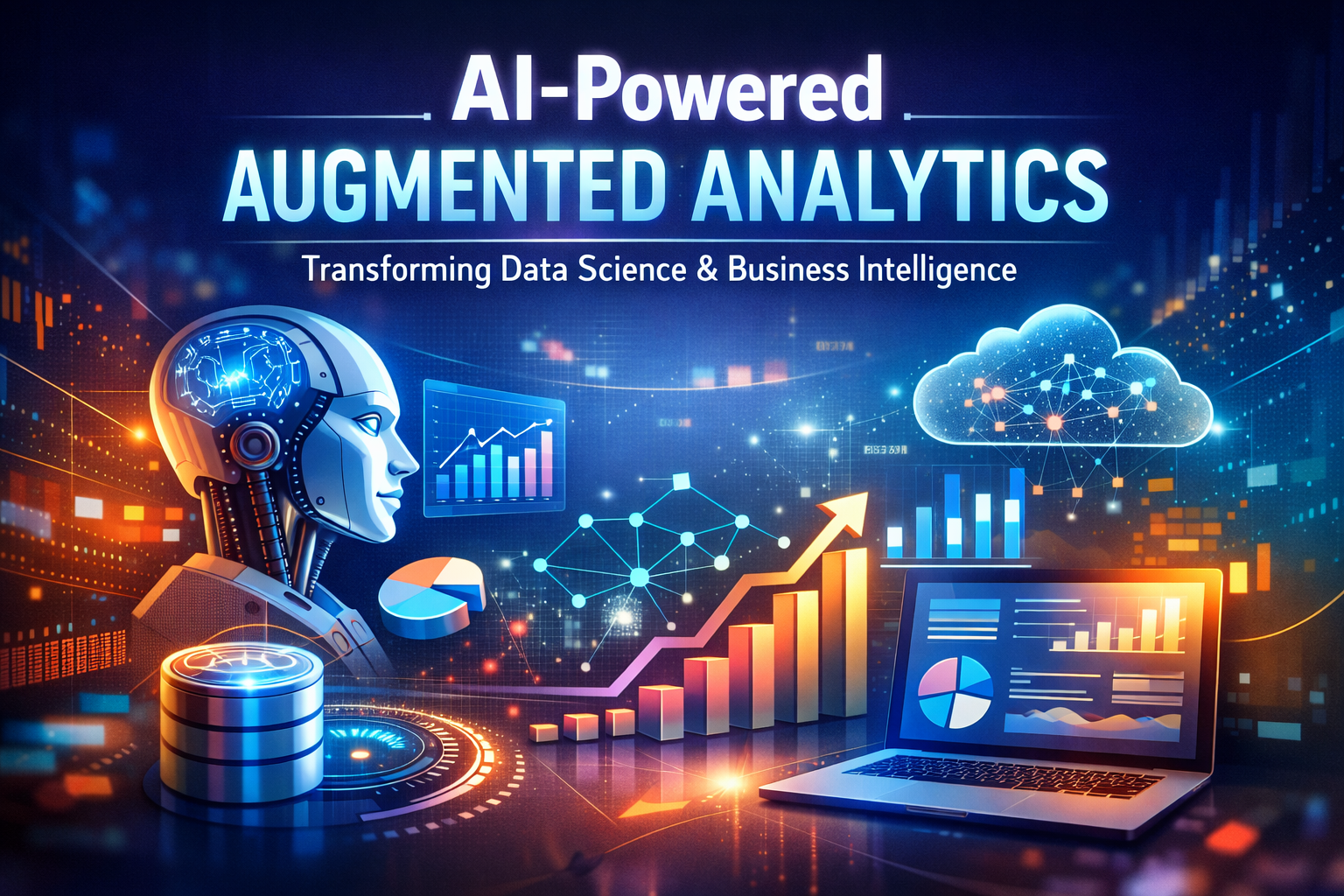
The field of Data Science & Analytics is evolving faster than ever, driven by rapid advances in artificial intelligence, cloud computing, and automation. Among all emerging trends, AI-Powered Augmented Analytics has clearly positioned itself as the most impactful and widely adopted direction for modern organizations. It represents a fundamental shift in how data is analyzed, interpreted, and transformed into business value.
As companies face growing volumes of big data, traditional analytics methods are no longer sufficient. Decision-makers now require faster insights, reduced dependency on technical teams, and analytics systems that can think alongside humans. This is where augmented analytics becomes the cornerstone of next-generation business intelligence.
Understanding Augmented Analytics
Augmented analytics refers to the use of machine learning, natural language processing (NLP), and AI analytics software to automate data preparation, insight discovery, and explanation. Instead of manually writing queries or building dashboards from scratch, users can interact with data through natural language and receive AI-generated insights in real time.
Unlike traditional analytics platforms, augmented analytics does not replace human analysts. Instead, it enhances their capabilities by automating repetitive tasks and surfacing insights that may otherwise go unnoticed.
Key components of augmented analytics include:
- Automated data cleaning and preparation
- AI-driven pattern detection
- Predictive analytics and forecasting
- Natural language query (NLQ) interfaces
- Automated data storytelling and explanations
Why AI-Powered Analytics Is Trending Now
Several converging factors have accelerated the adoption of AI-powered analytics platforms:
Explosion of Big Data
Organizations generate massive volumes of structured and unstructured data from applications, sensors, customer interactions, and digital platforms. Manual analysis cannot scale efficiently with this growth, making AI analytics tools essential.
Democratization of Business Intelligence
Business users increasingly want direct access to insights without relying on data teams. Self-service analytics powered by AI enables non-technical users to explore data independently.
Advances in Generative AI
Recent breakthroughs in generative models allow analytics systems to:
- Write SQL automatically
- Explain insights in plain language
- Generate dashboards and summaries instantly
This has transformed analytics software into intelligent assistants rather than static reporting tools.
Core Capabilities of Augmented Analytics Platforms
1. Automated Data Preparation
One of the most time-consuming aspects of analytics is preparing data. AI-driven data preparation automatically identifies missing values, detects anomalies, and suggests transformations. This dramatically reduces time-to-insight and improves data quality.
2. Natural Language Analytics
With natural language processing, users can ask questions like:
- “What caused the drop in sales last quarter?”
- “Which customer segment is growing fastest?”
The system translates these questions into queries and returns actionable insights. This capability is central to conversational analytics and modern BI tools.
3. Automated Insight Discovery
Instead of waiting for users to ask the right questions, augmented analytics proactively identifies trends, correlations, and outliers. This form of AI-driven insight discovery helps businesses uncover hidden opportunities and risks.
4. Predictive and Prescriptive Analytics
Beyond descriptive reporting, AI analytics software provides:
- Predictive analytics to forecast future outcomes
- Prescriptive analytics to recommend actions
This enables organizations to move from hindsight to foresight.
5. Explainable AI (XAI)
Trust is critical in analytics. Explainable AI ensures that users understand how insights and predictions are generated, increasing confidence and adoption across the organization.
Impact on Business Intelligence and Analytics Teams
The rise of AI-powered augmented analytics is reshaping roles across data teams:
- Data analysts focus more on strategy and interpretation rather than manual reporting
- Data engineers spend less time supporting ad-hoc queries
- Business users become active participants in analytics workflows
This shift improves collaboration and accelerates data-driven decision making.
Industry Use Cases of Augmented Analytics
Retail and E-commerce
Retailers use AI analytics platforms to analyze customer behavior, optimize pricing, and personalize recommendations. Automated insights help identify demand patterns and inventory risks in real time.
Finance and Banking
In financial services, augmented analytics supports fraud detection, risk modeling, and regulatory reporting. AI-driven anomaly detection improves accuracy while reducing manual effort.
Healthcare
Healthcare organizations leverage predictive analytics to improve patient outcomes, optimize resource allocation, and detect early warning signals in clinical data.
Manufacturing and Supply Chain
Real-time AI-powered analytics enables predictive maintenance, demand forecasting, and operational optimization, reducing downtime and costs.
Relationship Between Augmented Analytics and Data Science
While data science traditionally involves advanced statistical modeling and experimentation, augmented analytics operationalizes these capabilities for everyday use. It bridges the gap between complex models and business consumption.
Instead of requiring deep expertise in machine learning, augmented analytics embeds intelligence directly into analytics tools, making advanced insights accessible at scale.
Role of Cloud Analytics Platforms
Modern cloud-based analytics platforms play a critical role in enabling augmented analytics. Cloud infrastructure provides:
- Scalable compute for AI models
- Real-time data processing
- Seamless integration with enterprise data sources
As a result, AI-powered BI tools can deliver insights faster and more reliably than traditional on-premise systems.
Challenges and Considerations
Despite its advantages, organizations must address several challenges when adopting augmented analytics:
- Data governance and security: Ensuring AI operates on trusted, compliant data
- Model bias and transparency: Avoiding misleading insights
- Change management: Training users to trust and adopt AI-driven insights
Successful implementation requires aligning technology with business strategy and culture.
The Future of AI-Driven Analytics
Looking ahead, augmented analytics will continue to evolve toward:
- Autonomous analytics agents
- Deeper integration with enterprise applications
- More advanced real-time analytics
- Greater personalization of insights
Eventually, analytics systems will act as proactive decision partners, continuously monitoring data and recommending actions without being prompted.
Conclusion
AI-Powered Augmented Analytics is not just another trend—it represents a fundamental transformation in how organizations interact with data. By combining artificial intelligence, big data, and business intelligence, it empowers users at all levels to make faster, smarter, and more confident decisions.
As data volumes grow and business environments become more complex, adopting augmented analytics platforms will be essential for maintaining competitive advantage. Organizations that embrace this shift today will define the future of data-driven enterprises tomorrow.