The software development landscape is undergoing a profound transformation. Traditional programming workflows—once dominated by manual coding, rigid frameworks, and long development cycles—are being reshaped by a new generation of AI developer tools. These tools, combined with advances in APIs, no-code/low-code platforms, and cloud-native architectures, are redefining how applications are built, deployed, and maintained.
At the center of this shift are AI developer platforms, which integrate artificial intelligence directly into the development lifecycle. From code generation and testing to API orchestration and workflow automation, these platforms are changing not only how developers write software, but also who can participate in the creation of digital products.
Understanding AI Developer Platforms
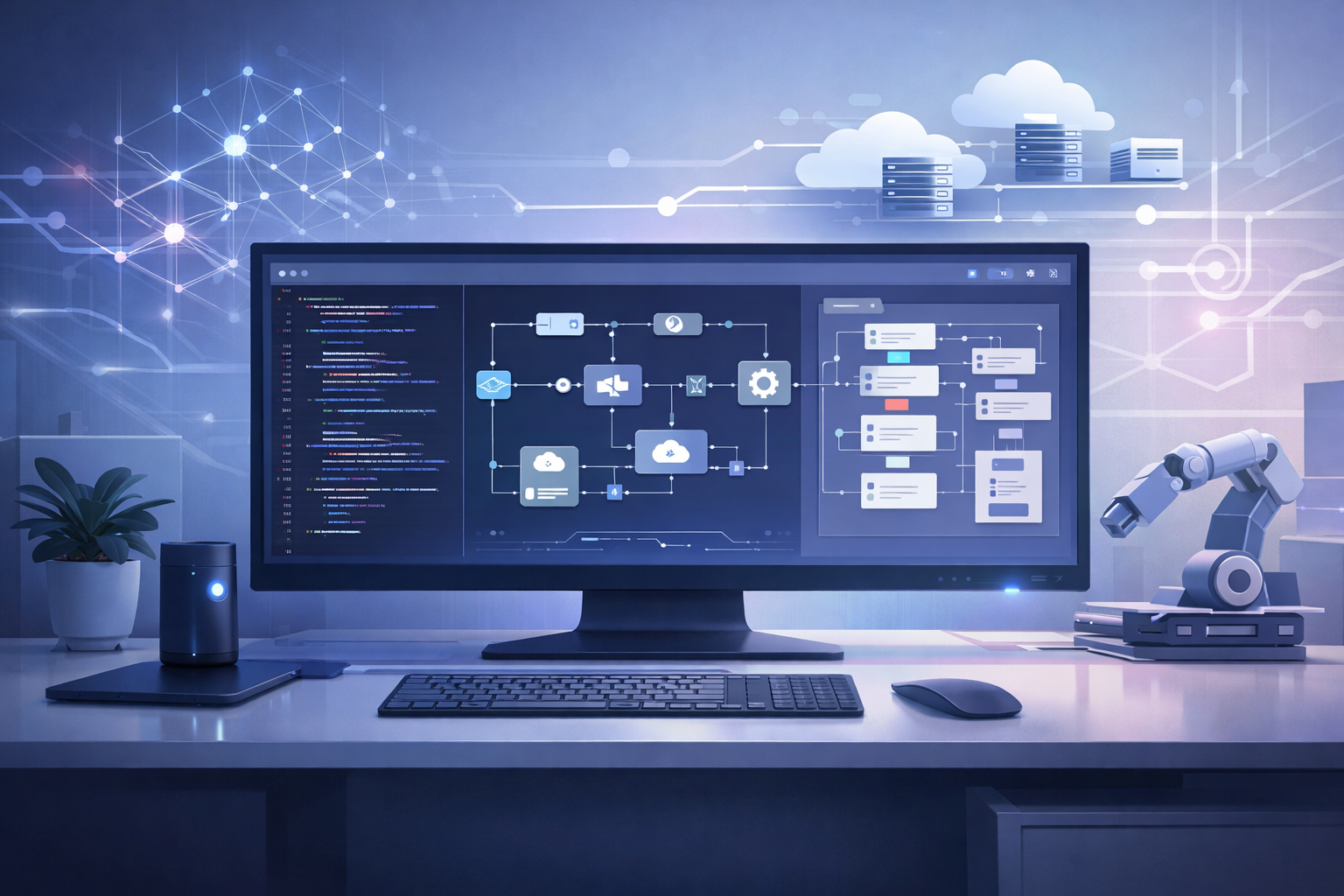
An AI developer platform is a unified environment that provides developers with AI-powered capabilities to assist or automate key stages of software development. Unlike standalone coding assistants, these platforms typically combine multiple features such as intelligent code completion, natural language programming, automated testing, and deployment pipelines.
What makes these platforms distinctive is their deep integration into existing programming tools, frameworks, and APIs. Rather than replacing developers, they act as force multipliers—enhancing productivity, reducing errors, and accelerating innovation. For teams under pressure to ship faster while maintaining quality, this combination is becoming essential.
Programming in the Age of AI Assistance
Programming has always required precision, logic, and experience. However, modern AI coding tools are reducing the cognitive load associated with repetitive or boilerplate tasks. Developers can now describe functionality in natural language and receive structured code suggestions aligned with best practices.
This shift does not eliminate the need for strong programming fundamentals. Instead, it allows developers to focus on higher-level design decisions, performance optimization, and system architecture. As a result, software development becomes less about syntax and more about problem-solving.
AI-assisted programming also plays a crucial role in onboarding new developers. Junior engineers can learn faster by seeing context-aware suggestions, while experienced developers can explore unfamiliar languages or frameworks with confidence.
APIs as the Backbone of Intelligent Systems
Modern applications rely heavily on APIs to communicate across services, platforms, and devices. With the rise of microservices and distributed systems, API design and management have become core developer skills. AI developer platforms are now bringing intelligence into this domain as well.
AI-powered API tools can automatically generate API schemas, validate requests, detect inconsistencies, and even recommend optimizations based on usage patterns. This significantly reduces the friction involved in building and maintaining large-scale API ecosystems.
Additionally, AI can monitor API performance and predict potential failures before they impact users. By integrating these capabilities directly into developer workflows, platforms ensure that APIs remain reliable, secure, and scalable throughout the application lifecycle.
No-Code and Low-Code Meet AI
The growth of no-code platforms and low-code development has already expanded access to software creation. Business users, product managers, and designers can now build functional applications without deep programming knowledge. When AI is layered on top of these platforms, their potential increases dramatically.
AI-enhanced no-code tools allow users to describe workflows, data models, or UI components in plain language. The platform then translates these descriptions into functional logic. This bridges the gap between technical and non-technical stakeholders, enabling faster experimentation and iteration.
For professional developers, low-code tools powered by AI serve as accelerators rather than replacements. Complex logic can still be customized through code, while repetitive components are handled automatically. This hybrid approach is especially effective for internal tools, dashboards, and process automation.
Automating the Software Development Lifecycle
Beyond writing code, software development involves testing, debugging, deployment, and maintenance. AI developer platforms are increasingly addressing these stages through automation and predictive analysis.
Automated testing tools can generate test cases based on code behavior, user stories, or API contracts. AI-driven debugging tools analyze logs and stack traces to identify root causes faster than traditional methods. In deployment, intelligent pipelines can adapt configurations based on environment conditions or historical performance data.
By automating these tasks, AI platforms reduce human error and free developers to focus on innovation. This leads to more stable releases and shorter feedback loops—critical advantages in competitive markets.
Collaboration and Knowledge Sharing
Modern development is rarely a solo activity. Teams are distributed, projects are complex, and knowledge is often fragmented. AI developer platforms are emerging as collaboration hubs that centralize code, documentation, and decision-making.
AI-powered documentation tools can automatically generate and update technical docs based on code changes. Knowledge graphs built into platforms help teams understand dependencies across services and APIs. This shared intelligence reduces onboarding time and prevents costly misunderstandings.
In large organizations, these capabilities are particularly valuable. They help maintain consistency across teams while preserving flexibility for experimentation and growth.
Security and Compliance Considerations
As AI becomes more embedded in development workflows, security and compliance remain critical concerns. AI developer platforms are increasingly incorporating features such as automated vulnerability detection, dependency scanning, and policy enforcement.
By analyzing code and APIs in real time, AI tools can flag insecure patterns before they reach production. This proactive approach is far more effective than traditional post-deployment audits. For industries with strict regulatory requirements, such built-in safeguards are becoming non-negotiable.
Importantly, these security features are most effective when integrated seamlessly into everyday programming tools. Developers are more likely to adopt best practices when they are guided, rather than constrained, by intelligent systems.
Challenges and Limitations
Despite their promise, AI developer tools are not without limitations. Over-reliance on generated code can lead to shallow understanding, especially for less experienced developers. There are also concerns around bias, maintainability, and the transparency of AI-generated logic.
Additionally, integrating AI platforms into existing toolchains can be complex. Organizations must consider data privacy, model governance, and long-term costs. Successful adoption requires not just new tools, but also cultural shifts in how teams approach development.
Understanding these challenges is essential for making informed decisions about where and how to use AI in software projects.
The Future of Developer Technology
Looking ahead, AI developer platforms are likely to become standard components of the development stack. As models improve and integrations deepen, the boundary between idea and implementation will continue to shrink.
Future platforms may offer fully conversational development environments, where developers design systems through dialogue and visual feedback. APIs, workflows, and user interfaces could be generated, tested, and refined in near real time. In this future, programming becomes more accessible, collaborative, and creative.
Rather than replacing developers, AI will redefine their role—elevating them from code writers to system designers and problem solvers.
Conclusion
The convergence of programming, APIs, no-code/low-code platforms, and AI developer tools marks a pivotal moment in software development. AI developer platforms are not just improving efficiency; they are reshaping how software is conceived, built, and evolved.
For developers and organizations alike, embracing these tools is no longer optional. Those who understand and leverage AI-driven development will be better positioned to innovate, scale, and compete in an increasingly digital world.