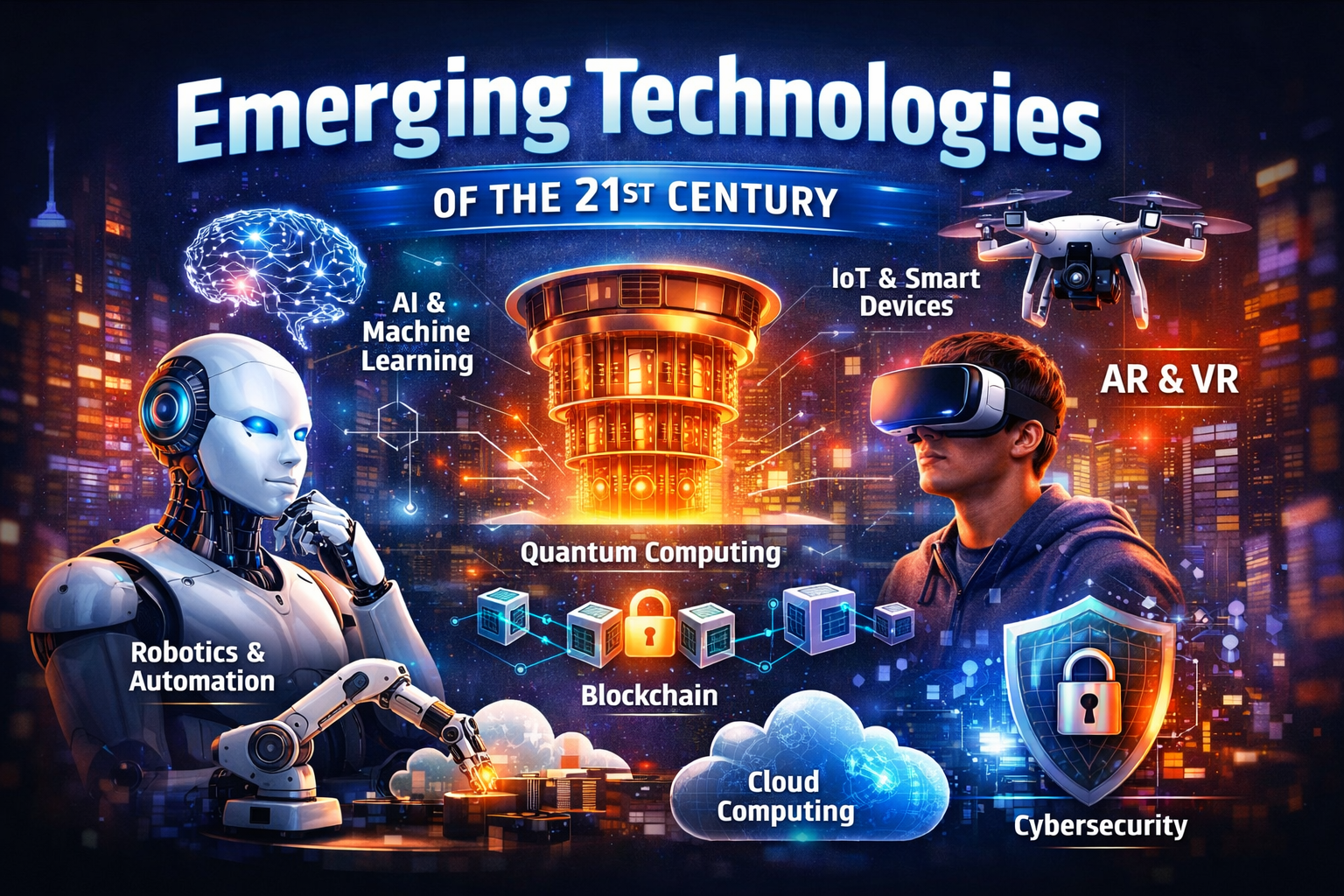
The 21st century has brought a rapid transformation in the way humans live, work, communicate, and think. Technology is no longer limited to computers and mobile phones. Today, emerging technologies of the 21st century are shaping industries, creating new career opportunities, and solving real-world problems. From intelligent machines to virtual worlds, these innovations are changing the future faster than ever before.
This article explains the most important and most searched emerging technologies, in simple language, so anyone can understand how they work and why they matter.
What Are Emerging Technologies?
Emerging technologies are new or advanced technologies that are currently developing or will be widely used in the near future. These technologies often improve efficiency, reduce human effort, and create smarter systems. Many of them are still evolving, but their impact is already visible across industries like healthcare, education, finance, manufacturing, and entertainment.
Artificial Intelligence (AI)
Artificial Intelligence is one of the most powerful technologies of the 21st century. It allows machines to think, learn, and make decisions like humans. AI systems analyze large amounts of data and identify patterns to provide accurate results.
Today, AI in daily life is everywhere. Voice assistants, recommendation systems, chatbots, face recognition, and language translation tools are all powered by AI. Businesses use AI to automate tasks, improve customer service, and make better decisions.
The future of AI looks even more advanced, with smart cities, self-driving vehicles, and AI-powered healthcare becoming more common.
Generative AI
Generative AI is a modern branch of artificial intelligence that creates new content instead of just analyzing data. It can generate text, images, videos, music, and code based on user input.
Popular uses of Generative AI tools include writing articles, designing graphics, creating marketing content, and building software faster. Unlike traditional AI, generative systems focus on creativity and content creation.
The rise of Generative AI examples shows how technology is changing jobs and workflows, helping individuals and businesses work more efficiently.
Machine Learning
Machine Learning is a core part of artificial intelligence. It allows systems to learn from data without being explicitly programmed. The more data a machine learning model receives, the better it becomes at predicting outcomes.
There are different types of Machine Learning, including supervised, unsupervised, and reinforcement learning. These models are used in spam detection, fraud detection, product recommendations, and medical diagnosis.
Understanding Machine Learning applications is important for anyone interested in data-driven technologies and future tech careers.
Internet of Things (IoT)
The Internet of Things connects physical devices to the internet, allowing them to collect and exchange data. These devices include smart home appliances, wearable fitness trackers, smart meters, and connected vehicles.
IoT examples in daily life include smart lights, smart security systems, and health monitoring devices. In industries, IoT improves productivity, safety, and resource management.
As smart technology continues to grow, IoT will play a major role in building intelligent homes and cities.
Blockchain Technology
Blockchain technology is a secure and transparent way of storing data across multiple systems. Instead of relying on a single authority, blockchain uses a decentralized network to record transactions.
Although it is widely known for digital currencies, blockchain use cases extend far beyond that. It is used in supply chain management, digital identity verification, healthcare records, and secure data sharing.
The future of blockchain technology lies in creating trust, transparency, and security in digital systems.
Cybersecurity Technologies
With increasing digital activity, cybersecurity has become essential. Cybersecurity technologies protect systems, networks, and data from digital attacks, unauthorized access, and data breaches.
Common types of cyber threats include phishing, malware, ransomware, and identity theft. To counter these threats, organizations use firewalls, encryption, intrusion detection systems, and AI-based security tools.
The future of cybersecurity focuses on advanced threat detection and proactive defense as cyber risks continue to grow.
Cloud Computing
Cloud computing allows users to store data and run applications over the internet instead of relying on physical servers. It provides flexibility, scalability, and cost efficiency.
There are different types of cloud computing, including public, private, and hybrid clouds. Businesses use cloud platforms for data storage, collaboration, software development, and remote work.
The benefits of cloud computing make it one of the most widely adopted technologies in the modern digital world.
Quantum Computing
Quantum computing is an advanced form of computing that uses quantum mechanics to solve complex problems much faster than traditional computers. While classical computers use bits, quantum computers use qubits.
This technology has the potential to revolutionize fields like cryptography, drug discovery, financial modeling, and climate research. Although still in early stages, the future of quantum computing is highly promising.
Many people search for quantum computing explained simply because of its revolutionary potential.
Augmented Reality (AR) and Virtual Reality (VR)
Augmented Reality enhances the real world by adding digital elements, while Virtual Reality creates a completely immersive digital environment.
AR and VR technologies are widely used in gaming, education, training, healthcare, and real estate. Virtual classrooms, 3D simulations, and interactive learning experiences are becoming more common.
The future of AR and VR includes advanced virtual workspaces and realistic digital experiences.
Robotics and Automation
Robotics involves designing machines that can perform tasks automatically. Combined with AI, robots are becoming smarter and more adaptable.
Automation technology is used in manufacturing, healthcare, logistics, and agriculture. Robots assist in surgeries, factory operations, warehouse management, and even customer service.
The future of robotics focuses on improving efficiency, reducing human workload, and enhancing safety in complex environments.
Why Emerging Technologies Matter
The emerging technologies of the 21st century are not just trends; they are shaping the future of humanity. They improve productivity, create new industries, and open doors to innovative career paths.
Understanding these technologies helps individuals stay competitive, businesses grow smarter, and societies become more connected and efficient.
Conclusion
From Artificial Intelligence to Quantum Computing, emerging technologies are redefining how the world operates. Each technology plays a unique role, but together they create a smarter, faster, and more connected future.
Learning about these innovations today prepares us for the opportunities of tomorrow. As technology continues to evolve, staying informed about these future technologies is essential for personal growth and professional success.