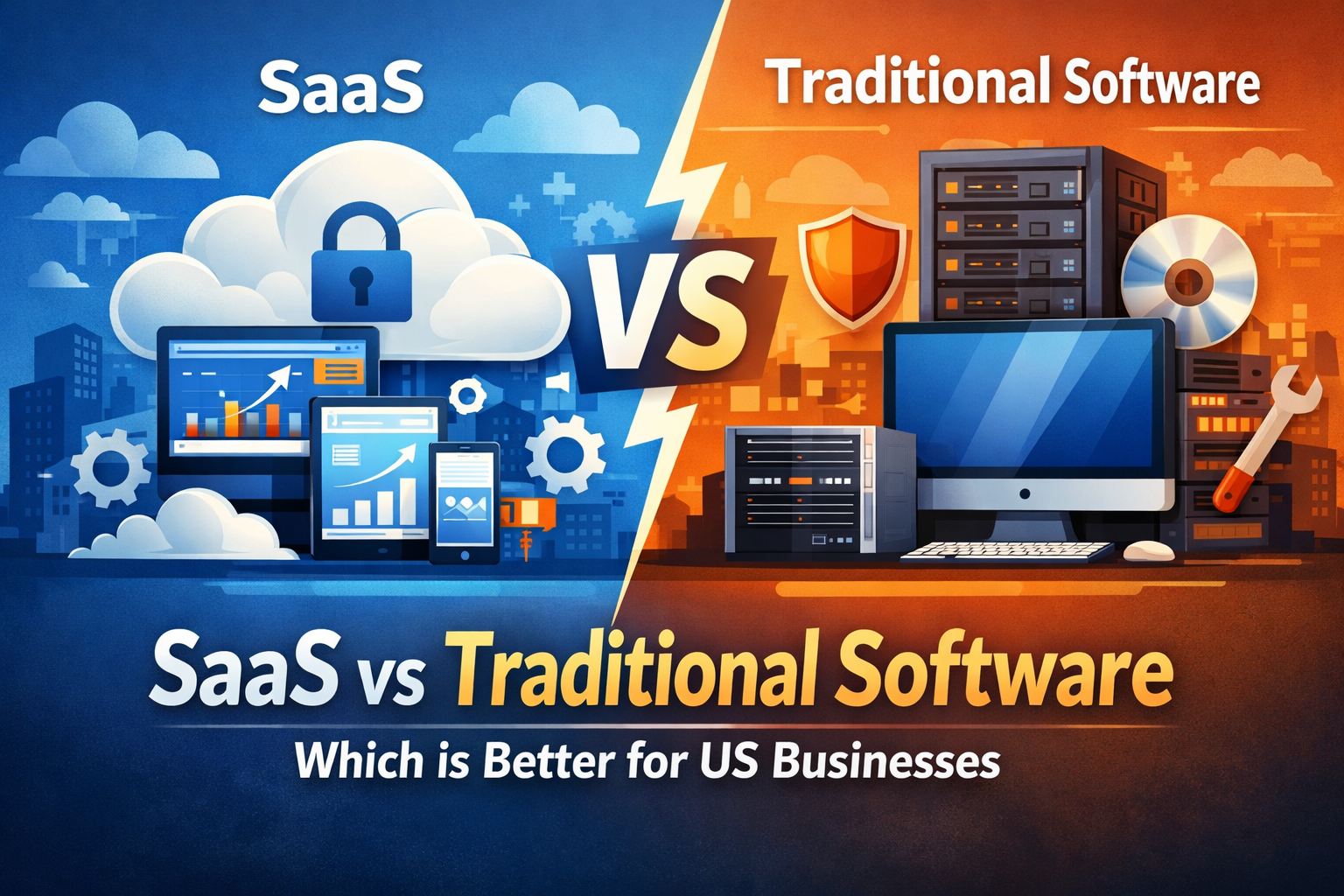
In today’s rapidly evolving business environment, US companies are constantly seeking software solutions that optimize operations, enhance efficiency, and reduce costs. The debate between SaaS (Software as a Service) and traditional software is central to this decision. Both approaches have distinct advantages and limitations, making it critical for businesses to understand which solution aligns best with their operational needs.
What is SaaS?
SaaS, or Software as a Service, is a cloud-based software delivery model where applications are hosted by a service provider and made accessible to users over the internet. Unlike traditional software, SaaS eliminates the need for physical installation and maintenance on local computers or servers. Popular examples include CRM software, accounting tools, and project management applications.
Key features of SaaS solutions include:
- Subscription-based pricing: Businesses pay a recurring fee, usually monthly or annually, instead of a one-time license.
- Automatic updates: The software provider manages updates, ensuring users always have access to the latest features.
- Scalability: Companies can adjust their subscription plans based on user demand.
- Accessibility: Employees can access SaaS applications from any device with an internet connection, supporting remote work.
These characteristics make SaaS an attractive option for startups, small businesses, and enterprises looking for flexibility and reduced IT overhead.
What is Traditional Software?
Traditional software, also referred to as on-premises software, is installed directly onto a company’s hardware infrastructure. This software requires local maintenance, updates, and security management by the company’s IT team.
Key characteristics of traditional software include:
- One-time purchase: Businesses pay an upfront cost for a perpetual license.
- Internal control: Companies have full control over data, security, and customization.
- Hardware dependency: Software performance relies on the company’s servers or individual computers.
- Manual updates: The IT team is responsible for installing updates and patches.
While traditional software offers a sense of control and security, it often demands higher initial investment, continuous maintenance, and significant IT expertise.
Cost Comparison: SaaS vs Traditional Software
Cost is one of the most significant factors US businesses consider when choosing between SaaS software and traditional software.
SaaS software follows a subscription model, making it easier for businesses to predict expenses and reduce capital expenditure. There are no large upfront costs, and companies can scale usage based on requirements. Additionally, the provider handles maintenance, reducing ongoing operational costs.
On the other hand, traditional software requires a substantial initial investment for licensing, installation, and hardware setup. Over time, maintenance, updates, and IT staffing increase the total cost of ownership (TCO). For larger enterprises, the upfront expense can be justified, but for small and mid-sized US businesses, SaaS often proves more economical.
Implementation and Deployment
SaaS applications are known for their quick deployment. Since the software is cloud-based, setup is typically faster and simpler, often taking a few hours or days. Businesses do not need to worry about server configuration, database management, or complex installation processes.
Traditional software, however, can take weeks or even months to deploy. Companies must install the software on local machines, configure servers, and ensure compatibility with existing systems. Implementation delays can affect productivity and operational efficiency.
Flexibility and Scalability
One of the standout advantages of SaaS for US businesses is scalability. As companies grow, they can easily upgrade or downgrade plans, add users, or expand features without significant disruption. This flexibility is ideal for businesses with fluctuating demands, seasonal peaks, or expansion plans.
Traditional software offers limited scalability. Increasing capacity often requires purchasing additional licenses, upgrading hardware, or investing in new infrastructure. This lack of flexibility can be a barrier for fast-growing US businesses.
Security Considerations
Security is a critical concern for US businesses evaluating SaaS vs traditional software.
SaaS providers invest heavily in security measures, including encryption, data redundancy, and compliance with industry regulations like HIPAA or SOC 2. While some businesses worry about storing sensitive information offsite, reputable SaaS providers maintain robust security protocols and disaster recovery systems.
Traditional software, on the other hand, allows companies to keep sensitive data on-premises, providing direct control over security. However, this requires a skilled IT team to manage updates, patches, and potential vulnerabilities. For businesses lacking internal cybersecurity expertise, traditional software can present a higher risk if not managed properly.
Customization and Integration
Traditional software often allows for deeper customization to meet unique business needs. US companies with complex workflows may prefer on-premises solutions for this reason. Integrating traditional software with existing systems is usually straightforward but can require professional IT services.
SaaS applications, while improving in customization options, may have some limitations compared to traditional software. However, many SaaS solutions offer extensive integrations with popular tools such as CRM platforms, ERP systems, and marketing automation software, enabling US businesses to create a connected technology ecosystem.
Maintenance and Support
SaaS solutions relieve businesses from the burden of system maintenance. Updates, bug fixes, and technical support are handled by the provider. This allows IT teams to focus on strategic initiatives rather than routine maintenance.
With traditional software, the company bears full responsibility for maintenance, troubleshooting, and upgrades. This can require a dedicated IT team and incur additional costs, particularly for small to mid-sized businesses.
Accessibility and Remote Work
The rise of remote work in the US has made cloud-based SaaS increasingly attractive. Employees can access SaaS applications from any location using a secure internet connection, enabling seamless collaboration. Mobile access and cross-platform compatibility further enhance productivity.
Traditional software may limit accessibility, especially for remote teams, as it typically requires local installation or VPN connections to company servers. This can create barriers to collaboration and slow response times.
Total Cost of Ownership
When evaluating SaaS vs traditional software, it’s essential for US businesses to consider total cost of ownership (TCO), including licensing, implementation, maintenance, security, and upgrades. While traditional software may appear cheaper in the short term for some enterprises, SaaS often proves more cost-effective over time due to lower upfront costs, reduced IT overhead, and predictable subscription pricing.
Use Cases: When to Choose SaaS
SaaS software is ideal for US businesses that:
- Have limited IT resources.
- Require flexible scalability.
- Operate remote or hybrid teams.
- Prefer predictable subscription costs.
- Seek rapid deployment and easy integration with existing tools.
Common SaaS categories include project management software, email marketing platforms, accounting software, and customer relationship management tools.
Use Cases: When to Choose Traditional Software
Traditional software is better suited for businesses that:
- Handle highly sensitive or regulated data.
- Require extensive customization.
- Have a robust IT team to manage infrastructure.
- Prefer one-time purchase to recurring subscription fees.
Industries such as finance, healthcare, and government services may favor traditional software due to strict compliance requirements and data control needs.
Conclusion: SaaS vs Traditional Software for US Businesses
Choosing between SaaS and traditional software depends on a business’s specific needs, budget, and growth strategy.
For most US businesses, SaaS solutions offer superior flexibility, scalability, and cost-effectiveness, particularly for startups, small businesses, and companies embracing remote work. Its subscription model, automatic updates, and cloud accessibility make it an attractive choice in a dynamic market.
Traditional software, however, continues to be relevant for companies with specialized security needs, complex workflows, or industries requiring extensive customization. While it demands higher upfront investment and ongoing maintenance, the control it provides can be invaluable in certain contexts.
Ultimately, US businesses should carefully evaluate their operational requirements, IT capabilities, and long-term strategy to determine the most suitable solution. A well-informed choice between SaaS vs traditional software can significantly impact productivity, cost-efficiency, and overall business success in 2026 and beyond.