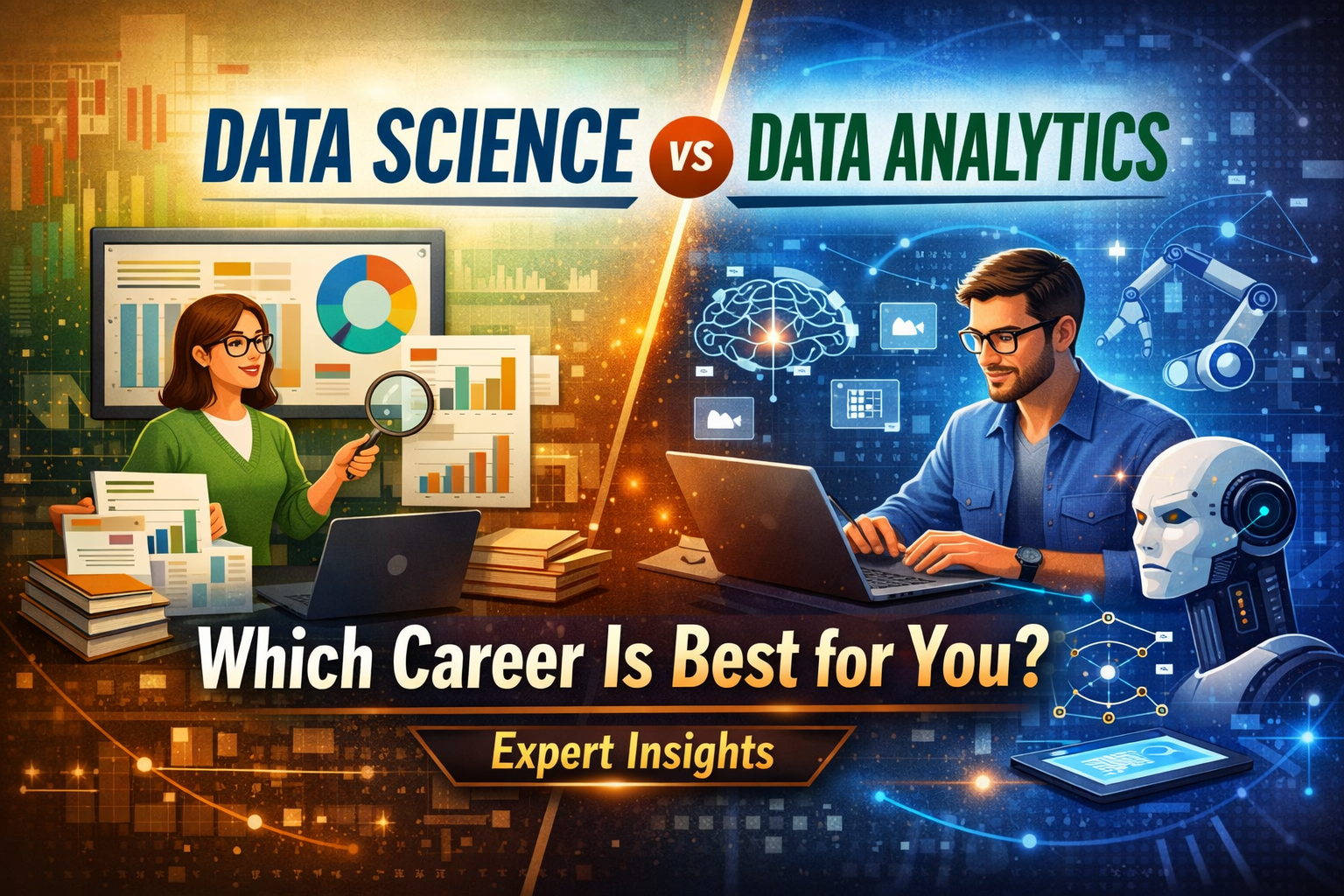
Choosing between Data Science and Data Analytics is one of the most common career dilemmas for students and professionals entering the data field. Both careers are high-paying, future-proof, and in demand across industries. However, they are not the same. According to industry experts, the best career for you depends on your skills, interests, and long-term goals.
This article provides a detailed expert-based comparison of Data Science vs Data Analytics, covering skills, job roles, salaries, learning difficulty, career growth, and who should choose which path.
Understanding the Data Domain
Before comparing the two careers, it is important to understand the broader data ecosystem. Organizations collect massive amounts of data daily. Turning this raw data into business value requires professionals who can analyze, interpret, and predict outcomes.
This is where Data Analytics and Data Science play different but complementary roles.
What Is Data Analytics?
Data Analytics focuses on examining historical and current data to answer specific business questions. The goal is to identify patterns, trends, and insights that help companies make informed decisions.
Key Responsibilities of a Data Analyst
- Cleaning and organizing data
- Analyzing datasets to find trends
- Creating dashboards and reports
- Supporting business decision-making
- Communicating insights to stakeholders
Experts describe Data Analytics as a decision-support career rather than a predictive one.
Common Tools Used in Data Analytics
- Excel and Google Sheets
- SQL
- Power BI and Tableau
- Python or R (basic to intermediate)
What Is Data Science?
Data Science is a more advanced and technical field. It goes beyond analysis and focuses on building predictive models, machine learning systems, and AI-driven solutions.
A Data Scientist works with both structured and unstructured data to predict future outcomes and automate decision-making.
Key Responsibilities of a Data Scientist
- Data collection and preprocessing
- Feature engineering
- Building machine learning models
- Statistical modeling
- Model evaluation and optimization
- Deploying data-driven solutions
Experts often call Data Science a research-oriented and innovation-driven career.
Common Tools Used in Data Science
- Python and R (advanced level)
- Machine learning libraries
- Deep learning frameworks
- SQL and NoSQL databases
- Big data tools
Core Difference: Data Science vs Data Analytics
According to experts, the main difference lies in purpose and depth.
- Data Analytics answers: What happened and why?
- Data Science answers: What will happen next and how can we optimize it?
| Aspect | Data Analytics | Data Science |
|---|---|---|
| Focus | Past and present data | Future predictions |
| Complexity | Moderate | High |
| Math & Statistics | Basic to intermediate | Advanced |
| Programming | Optional to moderate | Mandatory |
| Business Interaction | High | Medium |
| AI & ML | Rare | Core component |
Skills Required: Expert Perspective
Data Analytics Skills
Experts recommend Data Analytics for people who enjoy:
- Working with business data
- Visual storytelling
- Problem-solving using dashboards
- Communicating insights
Key skills include:
- SQL and Excel
- Data visualization
- Business intelligence tools
- Basic statistics
Data Science Skills
Experts suggest Data Science for individuals who enjoy:
- Coding and algorithms
- Mathematics and probability
- Machine learning and AI
- Experimentation and research
Key skills include:
- Python programming
- Machine learning algorithms
- Advanced statistics
- Data modeling
Career Entry Difficulty: What Experts Say
One of the biggest deciding factors is ease of entry.
Data Analytics: Easier Entry
Experts agree that Data Analytics is more beginner-friendly. Freshers, non-technical graduates, and career switchers can enter this field faster with focused learning.
You can become job-ready in 6–9 months with consistent practice.
Data Science: Steeper Learning Curve
Data Science has a higher entry barrier. Experts recommend at least 12–18 months of serious learning, especially for beginners.
Strong foundations in:
- Mathematics
- Programming
- Statistics
are essential.
Salary Comparison Based on Expert Reports
While both careers offer competitive pay, Data Science generally pays more due to its technical complexity.
Data Analytics Salary Insights
- Entry-level roles offer stable income
- Growth is steady with experience
- Salary increases with domain expertise
Data Science Salary Insights
- Higher starting salaries in many companies
- Rapid salary growth with advanced skills
- Premium pay for AI and ML expertise
Experts emphasize that skills matter more than titles in both careers.
Career Growth and Long-Term Opportunities
Data Analytics Career Growth
Data Analysts can grow into roles such as:
- Senior Data Analyst
- Business Analyst
- Analytics Manager
- Product Analyst
Experts say Data Analytics is ideal for leadership and strategy-oriented roles.
Data Science Career Growth
Data Scientists can advance into:
- Senior Data Scientist
- Machine Learning Engineer
- AI Specialist
- Research Scientist
Experts believe Data Science offers more opportunities in AI-driven industries.
Industry Demand: Expert Observations
Experts agree that both careers are in demand, but demand varies by industry.
- Data Analytics is widely used in finance, marketing, healthcare, retail, and operations
- Data Science dominates AI, fintech, autonomous systems, and advanced technology sectors
Organizations often start with Data Analytics and later adopt Data Science as they mature.
Which Career Is Best for You?
According to experts, the “best” career depends entirely on you.
Choose Data Analytics If:
- You want a faster career start
- You enjoy working with business data
- You prefer visualization and reporting
- You want less coding and math
Choose Data Science If:
- You enjoy programming and algorithms
- You want to work on AI and ML
- You like solving complex problems
- You aim for high-end technical roles
Expert Final Verdict
Experts do not consider Data Science vs Data Analytics as a competition. Instead, they see them as two different career paths serving different goals.
- Data Analytics is ideal for decision-makers and business-focused professionals
- Data Science is best for innovators, researchers, and AI-focused technologists
Many experts also recommend starting with Data Analytics and transitioning into Data Science over time, as it builds strong real-world data understanding.
Conclusion
Both Data Science and Data Analytics are excellent career options with long-term stability and growth. There is no universal “best” choice. The right path depends on your skills, interests, learning capacity, and career vision.
If you value business insights and quick entry, Data Analytics is the smarter choice. If you aim to work with AI, machine learning, and future technologies, Data Science is worth the effort.
Understanding yourself is more important than following trends. Choose the path that aligns with who you are and where you want to go.