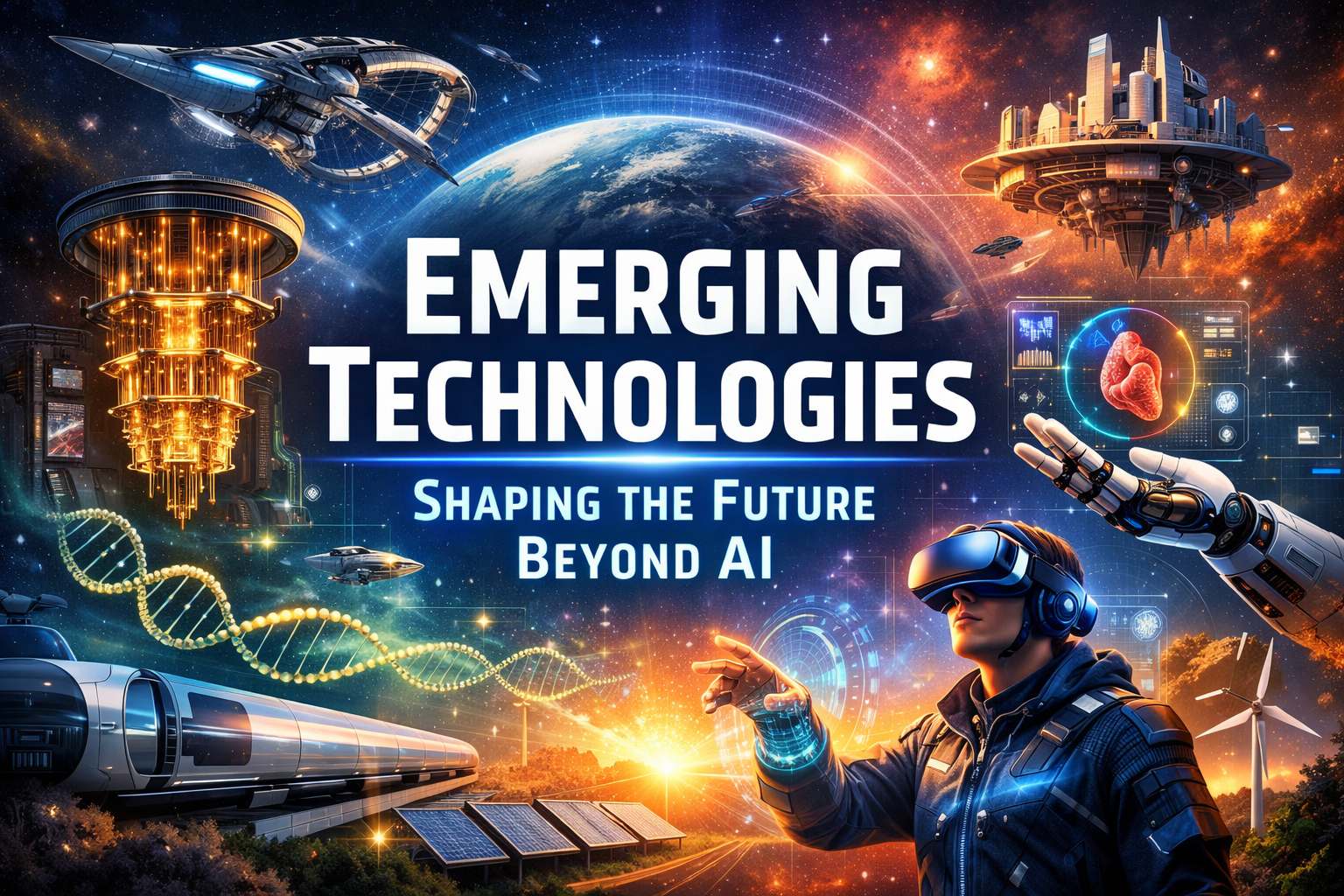
While artificial intelligence continues to dominate conversations about innovation, the future of technology extends far beyond AI alone. A new wave of emerging technologies is quietly redefining how we live, work, communicate, and interact with the physical and digital worlds. Technologies such as blockchain, augmented and virtual reality (AR/VR), Internet of Things (IoT), robotics, and quantum computing are converging to create transformative systems that will shape the next several decades.
Understanding these technologies is essential not only for businesses and policymakers but also for individuals preparing for a rapidly evolving digital society. This article explores the most influential emerging technologies beyond AI, their current state, and their future potential.
Blockchain: Redefining Trust and Decentralization
Blockchain technology is often associated with cryptocurrencies, but its true potential lies far beyond digital currencies. At its core, blockchain is a decentralized ledger system that records transactions in a secure, transparent, and immutable manner.
One of the most important impacts of blockchain is its ability to eliminate the need for centralized intermediaries. In sectors such as finance, supply chain management, healthcare, and digital identity, blockchain enables peer-to-peer transactions that are verifiable and resistant to tampering.
For example, smart contracts allow agreements to be executed automatically once predefined conditions are met, reducing fraud and administrative overhead. In supply chains, distributed ledger technology can track goods from origin to destination, improving transparency and accountability.
Looking ahead, blockchain will play a key role in decentralized finance (DeFi), tokenized assets, digital governance, and data ownership, empowering individuals with greater control over their digital lives.
Augmented Reality and Virtual Reality: Blending Physical and Digital Worlds
Augmented reality (AR) and virtual reality (VR) are reshaping how humans interact with information, environments, and each other. While VR immerses users in fully digital environments, AR overlays digital content onto the real world.
These technologies are already transforming gaming and entertainment, but their broader impact will be felt across education, healthcare, manufacturing, and remote collaboration. For example, AR-based training systems allow workers to receive real-time instructions while performing complex tasks, improving accuracy and safety.
In healthcare, medical simulation using VR enables surgeons to practice procedures in risk-free virtual environments. In education, immersive learning environments help students grasp abstract concepts through interactive experiences.
As hardware becomes lighter, more affordable, and more powerful, AR and VR will form the foundation of the spatial computing era, where digital experiences are seamlessly integrated into everyday physical spaces.
Internet of Things (IoT): A Connected Intelligent Ecosystem
The Internet of Things (IoT) refers to networks of physical devices embedded with sensors, software, and connectivity, allowing them to collect and exchange data. From smart homes and wearable devices to industrial machinery and urban infrastructure, IoT is creating a deeply interconnected world.
In smart cities, IoT systems optimize traffic flow, reduce energy consumption, and improve public safety. In healthcare, remote patient monitoring devices enable continuous health tracking, improving early diagnosis and personalized care. In agriculture, precision farming technologies use sensor data to optimize irrigation, fertilizer use, and crop yields.
However, the rapid growth of IoT also raises challenges around data security, privacy, and interoperability. Addressing these issues will be critical as billions of connected devices come online.
In the future, IoT will evolve into autonomous systems that not only collect data but also act on it in real time, forming the backbone of intelligent environments.
Robotics: From Automation to Collaboration
Robotics technology has moved far beyond traditional industrial automation. Modern robots are becoming more adaptive, mobile, and capable of working alongside humans in shared environments.
In manufacturing, collaborative robots (cobots) assist human workers by handling repetitive or physically demanding tasks. In healthcare, surgical robots enhance precision, while rehabilitation robots support patient recovery. Service robots are increasingly used in logistics, hospitality, and disaster response.
Advances in sensor technology, materials science, and human-robot interaction are enabling robots to operate safely in unpredictable environments. Soft robotics, inspired by biological systems, is opening new possibilities for delicate manipulation and medical applications.
As robotics continues to mature, the focus will shift from pure automation to human-robot collaboration, augmenting human capabilities rather than replacing them.
Quantum Computing: Unlocking Exponential Processing Power
Quantum computing represents one of the most radical shifts in computing history. Unlike classical computers, which process information using binary bits, quantum computers use quantum bits (qubits) that can exist in multiple states simultaneously.
This property enables quantum computers to solve certain problems exponentially faster than traditional systems. Potential applications include drug discovery, materials science, cryptography, financial modeling, and climate simulation.
While large-scale, fault-tolerant quantum computers are still in development, progress in quantum hardware, quantum algorithms, and error correction is accelerating. Even early-stage quantum advantage could disrupt industries that rely on complex optimization and simulation.
In the long term, quantum computing will not replace classical computing but will complement it, forming hybrid computing architectures that tackle problems previously considered unsolvable.
Convergence of Emerging Technologies
One of the most important trends shaping the future is the convergence of emerging technologies. Blockchain, IoT, robotics, AR/VR, and quantum computing are not evolving in isolation. Instead, they are increasingly integrated into unified systems.
For instance, IoT devices secured by blockchain can ensure trustworthy data exchange. AR interfaces combined with robotics can enable intuitive control of machines in real time. Quantum computing paired with advanced simulations can accelerate innovation in robotics and materials.
This convergence will lead to cyber-physical systems that blur the boundaries between digital intelligence and the physical world, enabling smarter cities, industries, and healthcare systems.
Challenges and Ethical Considerations
Despite their promise, emerging technologies introduce significant challenges. Issues related to data privacy, cybersecurity, digital inequality, and workforce displacement must be addressed proactively.
Ethical governance frameworks, inclusive design, and transparent regulation will be essential to ensure that technological progress benefits society as a whole. Investing in digital skills development and technology literacy will also help individuals adapt to these changes.
Conclusion: Preparing for a Post-AI Technology Landscape
The future of innovation extends far beyond artificial intelligence. Blockchain, AR/VR, IoT, robotics, and quantum computing are reshaping industries, redefining human capabilities, and transforming global systems.
Organizations and individuals who understand and adapt to these emerging technologies will be better positioned to thrive in the coming decades. As these technologies converge, they will form the foundation of a more connected, immersive, and intelligent world—one where technology augments human potential rather than limits it.